
How to Choose a Cushion Cut Diamond for Your Engagement Ring
There is a reason the cushion cut has outlasted nearly every trend in fine jewellery. It has been catching candlelight since the 1700s, and it still looks just as at home on a hand today. Soft, rounded corners. A pillowed silhouette. A warmth that a round brilliant or a princess cut simply doesn't have.
If you're drawn to a cushion cut but don't know where to begin beyond "I like the way it looks" — that's exactly the right place to start. You don't need to become a gemologist to choose well. You just need to know which few details actually matter, and which ones are marketing noise. Here is what we'd tell you if you were sitting across from us at our showroom.
Not sure a cushion cut is right for you? Compare it against our other engagement ring design options.
What Exactly Is a Cushion Cut Diamond?
A cushion cut is a square or rectangular diamond with rounded corners and gently curved sides — the shape that gives it its name, because it resembles a small pillow. It typically has 58 facets, the same count as a round brilliant, which is part of why a well-cut cushion can throw off a serious amount of sparkle.
Its lineage traces back to the "old mine cut" of 18th-century Brazil, a precursor to modern faceting that prioritised keeping as much of the rough diamond as possible rather than maximising sparkle. Cutters have refined the shape considerably since then, but the cushion cut still carries that quiet, antique warmth in a way that newer cuts don't try to replicate.
In short: if a round diamond feels expected and a princess cut feels sharp, a cushion cut sits in between — familiar, but with softness.

The Four Faceting Styles of a Cushion Cut
This is the detail most first-time buyers have never heard of, and it changes the entire character of the stone far more than the outline does. "Cushion cut" describes the silhouette — the faceting style underneath is a separate decision, and it's the one that actually determines how the diamond sparkles.

1. Old Mine / Antique Cushion
The original cushion faceting style, dating to the 1700s. Large, chunky facets, a high crown, a deep pavilion, and often a visible culet (a small flat facet at the very base of the stone). The look is unmistakably vintage — broad, deliberate flashes of light rather than a scattering of sparkle. It's the rarest of the four styles today, since it isn't how most modern diamonds are cut. It recently went viral because of Taylor Swift's old mine cut engagement ring.
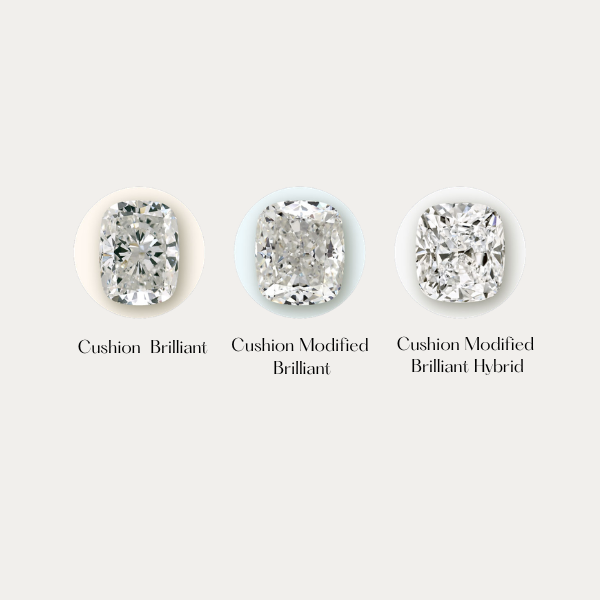
2. Cushion Brilliant
The modern evolution of the old mine cut, faceted more like a round brilliant — pavilion facets extend from the centre of the stone out to the girdle in a clean, star-like pattern. This produces large, well-defined flashes of light and a face-up look that's noticeably larger for its carat weight than the other styles. Because more rough diamond is sacrificed to cut this pattern precisely, well-cut cushion brilliants are the hardest of the four styles to source in fine quality — which is reflected in their price.
3. Cushion Modified Brilliant ("crushed ice")
The most commonly available style today. An extra row of facets is added below the girdle, and the pavilion facets stop short of reaching it rather than extending all the way — the technical reason behind the "crushed ice" look. Instead of a few bold flashes, light scatters across dozens of smaller facets, closer to how sugar or crushed ice catches light, which is where the name comes from. This style also tends to disguise colour and small inclusions more effectively than the other three.
4. Cushion Modified Brilliant Hybrid
A middle ground — the pavilion mains extend all the way to the girdle as in a cushion brilliant, which creates a visible X-shaped pattern at the centre of the table, but with modified facets woven in between them for extra sparkle. On a certificate, this will simply be labelled "cushion modified brilliant" — there's no separate category — so the only reliable way to tell it apart from a standard crushed ice cushion is to look at the stone itself, or its facet diagram if the report includes one.
| Style | Facet count | Look | Rarity |
|---|---|---|---|
| Old Mine / Antique | Fewer, larger | Bold, vintage flashes | Rare — a specialty cut today |
| Cushion Brilliant | ~57 | Large, star-like flashes, closest to a round brilliant | Rare in fine quality — most rough is sacrificed to cut it precisely |
| Cushion Modified Brilliant | ~64–70 | Soft, scattered "crushed ice" sparkle | Most widely available |
| Cushion Modified Hybrid | ~64–70, with extended mains | Blend of bold flashes and crushed ice, visible X-pattern | Uncommon, not separately certified |
None of these is objectively "better" — it's a matter of personality. If you're drawn to old-world character, look toward old mine or cushion brilliant. If you want a softer, more contemporary shimmer, crushed ice is the more available and typically more accessible choice. This is genuinely something worth seeing in person before deciding, since photographs flatten the difference considerably, and it's a large part of why we go through so many stones before we're satisfied with one for a client — more on that below.
Book a private viewing with us to discuss the differences
The Length-to-Width Ratio: Square or Elongated?
Every cushion cut diamond has a length-to-width ratio, and this single number tells you more about the stone's silhouette than any other spec.

| Ratio | Shape | Best for |
|---|---|---|
| 1.00 – 1.05 | True square, classic "pillow" | Traditional, symmetrical, heirloom-style rings |
| 1.05 – 1.15 | Slightly rectangular | The most popular middle ground — square enough to feel classic, long enough to feel modern |
| 1.15 and above | Elongated cushion | Appears larger face-up for the same carat weight, and tends to visually lengthen the finger |
There's no correct ratio — only the one that suits your taste and your hand. For a classic, traditional square look, the sweet spot is 1.00 to 1.05. If you prefer a more modern, elongated, and finger-flattering rectangular shape, the most popular and balanced ratio is between 1.20 and 1.30
Square cushions read as a true pillow shape — width and length are close to equal, so the outline feels compact, symmetrical, and grounded. This is the shape most associated with heirloom and antique jewellery, because it's closest to the original old mine cut. It tends to suit clients who want a diamond that feels substantial and settled on the hand, rather than one that draws the eye outward.
Elongated cushions stretch the same pillow shape along one axis. The visual effect is twofold: the diamond appears larger face-up for its actual carat weight, because the surface area is spread rather than concentrated, and it tends to visually lengthen the finger it's worn on — an effect similar to what an oval or emerald cut diamond does, but with the cushion's softer, rounded corners retained. This is currently the more requested proportion, particularly in the 1.15–1.30 range, because it reads as slightly more modern while still keeping the cushion's characteristic warmth.
A useful way to decide: if you tried on an oval or emerald cut and liked how it elongated your finger but wished it had softer corners, an elongated cushion is very likely your answer. If you tried on a princess cut and wanted the same compact symmetry with a gentler outline, a square cushion is the closer match.
The 4Cs, Reordered for Cushion Cuts
You've likely heard of the 4Cs — cut, colour, clarity, carat. For a round diamond, cut usually takes priority. For a cushion cut, the order shifts slightly, and knowing why will save you from paying for the wrong thing.
1. Colour matters more here than on almost any other shape
Cushion cuts have a larger, more open table (the flat top facet) than a round brilliant, and their broader facets don't break up light in quite the same way. The practical effect: any warmth or yellow tint in the diamond is more visible face-up than it would be on a round stone of the same grade.
- For a white or platinum setting, we recommend staying at F colour or above — colourless, with no visible warmth.
- If you're set on a yellow or rose gold setting, the metal itself will mask a touch more warmth, giving you a little more flexibility.
This is one of the few places where it's worth spending your budget on the spec rather than the size.
At Carat Heritage, our trained gemologists hand select only cushion diamonds in the colorless range - F color and above for our customers.
2. Clarity — because there's nowhere to hide
That same open table means inclusions have less faceting to disguise them. A clarity grade that would be perfectly eye-clean on a round or princess cut can occasionally show through on a cushion. We hand-select every stone at VS1 clarity or above specifically because it comfortably clears this bar — you shouldn't have to think about it, but it's worth knowing why we set the standard where we do.
3. Cut and proportions — the difference between sparkle and a "sleepy" stone
Trust your gemoloigists to pick the best, but if you have to do it yourself, look for a diamond with:
- Depth percentage under roughly 70%
- Table percentage under roughly 70%
- Excellent or Very Good polish and symmetry
A cushion cut with a depth that runs too deep will lose light out the sides, giving you a stone that looks noticeably darker in the centre — sometimes called a "sleepy" cushion. This is a case where trusting a hand-selected stone over a spreadsheet of numbers genuinely matters, because two diamonds with near-identical certificates can look meaningfully different in person.
4. Carat — sized differently than you'd expect
Cushion cuts are cut deeper than round brilliants, which means they carry more of their weight in depth rather than spread. In practical terms: a cushion cut often looks smaller, carat for carat, than a round diamond of the same weight — so if face-up size matters to you, it's worth trying on a stone rather than shopping by carat number alone.
New to the 4Cs entirely? Start with our full diamond grading guide.
Settings That Let a Cushion Cut Shine
The shape is versatile enough to suit almost any setting, but a few pairings bring out its character particularly well.
- Solitaire. The purest way to let a cushion cut's proportions and facet pattern speak for themselves. Best if you've fallen for the stone itself, not just the idea of a diamond.
- Halo. A ring of smaller diamonds around the centre stone visually rounds out the cushion's silhouette and adds brilliance — a popular pairing precisely because it plays to the shape's soft, romantic edges.
- Three-stone. Two side stones flank the cushion, adding finger coverage and a sense of occasion. A meaningful choice if the ring is meant to carry a story, not just a stone.
- Cathedral setting. Arched metal shoulders lift the diamond and add structural support — a good option if you're drawn to a slightly elevated, architectural look.
Compare every engagement ring design in detail in our full ring style guide.
Lab-Grown Cushion Cuts: What Changes, and What Doesn't
Nothing about the shape, the facet pattern, or the grading changes because a diamond is lab-grown. A lab-grown cushion cut is chemically, physically, and optically identical to a mined one — the only difference is where the crystal formed.
What it does change is what your budget can reach. Because lab-grown diamonds are more accessible in price than mined stones of comparable quality, choosing lab-grown often means you can move up in colour grade, clarity, or carat weight without moving your budget — which matters more on a cushion cut than on almost any other shape, for exactly the colour and clarity reasons above.
Every cushion cut we hand-select is IGI-certified, graded VS1 clarity and F colour or above, with the certificate accompanying your piece.
Curious about lab-grown vs. natural diamonds more broadly? Read our full comparison.
A Simple Way to Decide
If you take nothing else from this guide, narrow your decision down to three questions:
- Square or elongated? — decides your silhouette.
- Crushed ice or chunky facets? — decides your sparkle personality.
- White metal or warm metal? — decides how flexible you can be on colour grade.
Once you know the answers, choosing the right stone becomes a much shorter conversation than it might currently feel like.

Frequently Asked Questions
Are cushion cut diamonds more or less expensive than round diamonds? Contrary to what many buyers expect, a genuinely well-cut cushion can cost more than a round diamond of equal size and grade — not less. Cushion cuts have far less standardisation than round brilliants, and the proportions, faceting style, and symmetry that make a cushion look alive rather than "sleepy" are difficult to get right and harder still to find. On average, we go through 50 to 100 individual cushion cut stones to hand-select the one we're satisfied with for a single client's ring. That sourcing effort — not the shape itself — is what drives the price.
Do cushion cut diamonds sparkle as much as round diamonds? A well-cut cushion, particularly a crushed ice style, can sparkle close to a round brilliant. The character of that sparkle is different — softer flashes rather than the round's more uniform scintillation.
What colour grade should I choose for a cushion cut diamond? For a white or platinum setting, F colour or above is a safe standard, since cushion cuts show warmth more readily than round diamonds. Warmer metal settings allow slightly more flexibility.
Is a cushion cut a good choice for an everyday engagement ring? Yes. The 58-facet structure and rounded corners make it comfortably durable for daily wear, and the shape pairs well with most lifestyles.
Every cushion cut diamond in our collection is hand-selected and IGI-certified. If you'd like to see the difference between crushed ice and chunky facets, request a private viewing at our Orchard Road showroom.